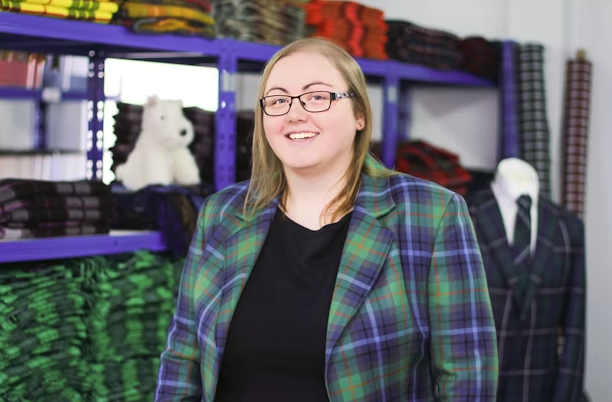
Emily joined ScotlandShop in 2014 shortly after completing her degree in Woven Textile Design. She is now the International Brand Manager at ScotlandShop, as well as the company’s in-house tartan designer. One of Emily’s standout projects to date was designing the Doddie’5 tartan for rugby legend Doddie Weir—a meaningful project connected to a charity that has proudly partnered with several of our Society events.
From idea to design – how does a tartan begin?
Q. When an organisation like the St Andrew’s Society Melbourne commissions a tartan, what does the process usually look like at the beginning? How do you turn an initial idea, colours, or story into the first tartan design?
The first step in the design process is always a consultation, either in person or via video call. It is so helpful to sit down and have a proper conversation, because designing a tartan is never just about colours and stripes. It is about the story behind it. I always enjoy learning more about why someone wants to create a tartan in the first place and what inspired the idea.
Sometimes there is already a strong starting point. There might be a connection to an existing tartan where we can borrow elements of the sett or colour palette as a subtle nod to heritage. Other times, the inspiration might be a set of colours that represent a place or organisation, or even a significant date or number that we can weave into the pattern. Every project starts a little differently depending on how much history or symbolism we have to work with, which is part of what makes each design so interesting.
From there, I create three initial design concepts. I’ve found this gives the client enough choice to explore different directions without it becoming overwhelming. At the beginning, I often have lots of ideas racing around, so creating those three designs helps me refine the strongest ones and shape them into something that really tells the story. I always like to step away from the designs for a while and come back with fresh eyes before sending them over, just to make sure they truly capture the brief and feel right.
Designing a tartan is a really special process because you are creating something that could represent an organisation or community for generations, so it is important to take the time to get it right.
The inspiration behind the St Andrew’s Society of Melbourne tartan draws beautifully on both Scottish and Australian identity. The blue reflects the Scottish flag, while heather represents one of Scotland’s most iconic native plants. To acknowledge the Society’s home in Australia, eucalyptus green has been incorporated as a nod to the country’s landscape and native flora. Navy blue references the official colour associated with both Melbourne and the state of Victoria, while black is included in recognition of the Australian Aboriginal flag. Together these elements create a tartan that celebrates Scottish heritage while honouring the Society’s deep connection to Melbourne and Australia.
Designing a tartan – what are the rules (and creative freedoms)?
Q. Tartans look simple at first glance but clearly involve a lot of detail. Are there traditional rules or patterns that designers follow, and how much creativity is allowed when developing something completely new?
As you say, tartans can look quite simple at first glance, but there is actually a lot of structure behind them. According to the Scottish Register of Tartans Act 2008, a tartan is defined as a design capable of being woven, consisting of two or more alternating coloured stripes that intersect vertically and horizontally to form a repeated checked pattern. The sequence of colours and stripes is known as the “sett”, and it repeats identically in both the warp (vertical threads) and the weft (horizontal threads), creating the distinctive pattern we recognise as tartan.
Traditionally, tartans are woven in a 2/2 twill construction, which gives the fabric its familiar diagonal appearance. Where a vertical stripe crosses a horizontal stripe of the same colour, a solid block of colour is formed. Where different colours cross, new shades referred to as half-tones are created through the weave. The thread count records the sequence of colours and the number of threads in each stripe, and it has often been described as the DNA of a tartan.
There are also some practical considerations, particularly when thinking about how the tartan will eventually be woven. For example, we work with even thread counts within each stripe, as this helps the pattern weave cleanly and keeps the symmetry balanced. A typical six-inch sett, which is around 15cm, might contain roughly 240 to 260 threads in total, although this can vary depending on the weight of the cloth and the scale of the design.
While most tartans are symmetrical, there are also some asymmetrical designs which can add another layer of possibility. Within those structural guidelines there is still plenty of room to tell a story through colour, proportion, and pattern, which is really where the fun of designing a tartan begins.
From digital design to woven cloth
Q. Once the tartan design is finalised, what happens next? Could you walk us through the journey from the design stage through to the tartan actually being woven and produced?
Once the design has been finalised, the next step is to have the tartan officially registered. We will come back to that in a little more detail later, but I always recommend having the design approved and registered before moving on to production.
From there we begin working with the mill. They will produce a printed CAD of the tartan to scale along with physical yarn samples so we can see how the colours will translate from screen to cloth. To do this we send over the thread count, which as mentioned earlier is essentially the DNA of the tartan, along with the colour references we used during the design stage. These might be hex codes, RGB values, or sometimes Pantone references, all of which help the mill match the yarn colours as closely as possible.
Once the mill prepares these samples, we share them with the client for final approval. Seeing the colours in yarn form is an important step because a colour that looks perfect digitally can behave slightly differently when woven.
After that, the real craftsmanship begins at the mill. The loom is set up with the warp threads arranged in the exact sequence of the thread count. The weft threads are then woven through them, recreating the sett and bringing the tartan to life in cloth form.
Once woven, the fabric goes through finishing. This is where it is washed, pressed, and prepared for use. After that it is ready to be transformed into all sorts of things, from kilts and accessories to tailored clothing and even interiors. It is always so special seeing something that started as a digital pattern become a physical tartan fabric.
Tartans around the world
Q. Many people associate tartans with Scottish clans, but today they’re created for organisations, regions, and even countries. What are some interesting or surprising tartans that have been created around the world?
There are now more than 15,000 tartans registered with the Scottish Register of Tartans, and as you mentioned they are created for all sorts of reasons. While many people still associate tartan primarily with Scottish clans, today they represent organisations, cities, charities, events, and sometimes just a bit of fun.
Some more unique examples are tartans registered for brands like Irn Bru & Hello Kitty & to celebrate things like Christmas, a Cuppa Tea & the Emperor Penguin.
At the other end of the spectrum, there have also been some fascinating historical discoveries. One of the biggest stories in the tartan world in recent years has been the Glen Affric tartan. This fragment of fabric was discovered in a peat bog in the Scottish Highlands in the 1980s, but it was more recently that radiocarbon testing confirmed its age. The Scottish Tartans Authority determined that it dates to between 1500 and 1600, during the reign of the Stuart monarchs, including Mary, Queen of Scots and her father James V. That discovery makes it the oldest known piece of true tartan ever found in Scotland, which is incredibly exciting because it gives us a rare physical link to how tartan was actually being worn and woven over 400 years ago. The Scottish Tartans Authority worked to re-create the fragment so this tartan is now being used around the world. It is a wonderful reminder that while tartan continues to evolve and be used in new ways around the world, it is also deeply rooted in history.
A personal favourite
Q. You must see hundreds of tartans in your role. Do you have a personal favourite, and what makes that particular tartan special to you?
It is incredibly hard to pick just one favourite, especially when every tartan carries its own story. I do have to give a special mention to the Wallace and Young clan tartans because of my family connections.
One that will always stand out to me is Doddie’5 tartan. It was the first tartan I ever designed professionally, and I had the privilege of working on it alongside the Scottish rugby legend Doddie Weir. The tartan was created to support the My Name’5 Doddie Foundation and raise funds for research into Motor Neurone Disease, so knowing that the design is helping support such an important cause makes it incredibly special.
There have been so many memorable projects over the years. The Albany tartan was a wonderful one to work on as it represents the city and county of Albany in Upstate New York and marked the opening of our first international ScotlandShop store.
A few other highlights include creating a tartan for tennis legend Billie Jean King for her 80th birthday, as well as designs for organisations such as Chest Heart & Stroke Scotland, Autism Acceptance, and The Royal Lyceum Theatre Edinburgh. Each project is completely different, but that is what makes designing tartans so rewarding.
“Once approved, the tartan becomes part of Scotland’s national tartan record, ensuring the design and the story behind it are preserved for generations to come.”
Registering a tartan
Q. The St Andrew’s Society Melbourne tartan has been officially registered with the Scottish Register of Tartans. Why is registration important, and what does the process involve when a new tartan is formally recorded?
The Scottish Register of Tartans was established by the Scottish Parliament through the Scottish Register of Tartans Act 2008. The aim was to create a single, official national archive to promote and preserve information about both historic and contemporary tartans from Scotland and around the world.
The Register launched in February 2009 and is administered by the National Records of Scotland, with guidance from the Court of the Lord Lyon and representatives of the Scottish tartan industry. Today, the database contains thousands of tartans and can be freely searched online. It also incorporates earlier records that were previously held by organisations such as the Scottish Tartans Authority and the Scottish Tartans World Register, bringing them together into one central resource.
Registering a tartan officially records and preserves the design for the future. It creates a permanent public record of the tartan, its story, its colours, and its thread count.
One of the main aims of the guidance in place when submitting a design is to ensure that each tartan is clearly unique and distinguishable from those already registered. The applicant must also demonstrate authority to use the name associated with the tartan. For example, if the design references a particular organisation, place, or country, approval would be required from a relevant office bearer or governing body to confirm the connection.
Once approved, the tartan becomes part of Scotland’s national tartan record, ensuring the design and the story behind it are preserved for generations to come.
I am fortunate to sit on the customer advisory panel for the National Records of Scotland, where we provide feedback on all the services they offer, for me this is with a particular focus on the Scottish Register of Tartans. It is a great opportunity to help shape how the register develops and continues to support both the tartan industry and the communities around the world that are creating new designs.
From Glasgow, Nick attended the University of Strathclyde and worked for 10 yrs
across Scotland in the House building and Property Development Industry. In 2008 Nick left
Scotland to pursue his career in Melbourne. Nick is currently a partner of a privately held Executive
Search group that specializes in the placement of key leadership appointments across a range of
Industries. As a natural connector of people both on and off the pitch, Nick founded the St Andrews
Society to connect like-minded Scottish Business leaders in Melbourne to share ideas and build long-
lasting relationships. Nick loves nothing more than a trip home to watch Scotland play rugby at
Murrayfield -if they are winning!